http://rpc.technorati.com/rpc/ping

bLogos

Grump tank for disgruntled atheists.

Empiricism

Empiricist philosophers take the position that sense experience is the ultimate source of all our concepts and knowledge. By contrast, rationalist philosophers make the claim that there are significant ways in which our concepts and knowledge are gained independently of sense experience.[1]

David Hume : John Locke

Jean Piaget's research into the development of cognitive schemas provides empirical support for the empiricist position. Piaget's experiments demonstrated that children incorporate experience to generate a progressively more logical construct concerning the operation of reality. That is, during the development of cognitive rationality, experiential information is assimilated and accommodated in a progression through increasingly more accurate reality-representational stages.

1. Markie, Peter, "Rationalism vs. Empiricism", The Stanford Encyclopedia of Philosophy (Fall 2004 Edition), Edward N. Zalta (ed.), URL.

Labels: , , , , , , , ,

Hume

David Hume (1711-1776) was a Scottish empiricist philosopher, economist, essayist, and historian. Hume is best remembered for "Humean skepticism". Hume considered philosophy to be the inductive, experimental science of human nature and considered himself chiefly as a moralist philosopher.

Hume built upon John Locke's epistemology and adapted the scientific method of Sir Isaac Newton as his model. He attempted to describe the operation of the mind in acquiring knowledge and concluded that there can be no knowledge of anything beyond experience. Hume raised the skeptical philosophical objection that inductive reasoning might fail whenever the past cannot be taken to be a reliable guide to the future.

"Does a man of sense run after every silly tale of hobgoblins or fairies, and canvass particularly the evidence? I never knew anyone, that examined and deliberated about nonsense who did not believe it before the end of his enquiries." ~ David Hume, Letters

Websites : Hume: Empiricist Naturalism : Hume texts online : David Hume: Writings on Religion : Hume on Religion : quotes from Hume's writings : philosophical skepticism : Skepticism :

Labels: , , , , ,

Popper

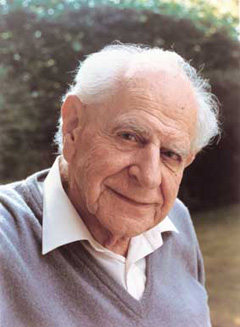
Karl Popper, philosopher of science.Karl Popper was a philosopher of science who is best known for his extension of David Hume's 'problem of induction' and for his work on the demarcation of science.

Popper argued that observation is selective and theory-laden and that there can be no pure or theory-free observations. He further argued that it is possible to select amongst observable data in such a way as to support personally favoured yet invalid theories.

(So-called creation 'science' and intelligent [sick] design theory are not science, and provide clear examples of the misinterpretation and misrepresentation of facts to fit a prior insistence on the existence of a creator. Here, I use prior to indicate that belief in a creator comes prior to the manipulation of the data to support the belief. Creation myths are the invention of humans in almost every culture and are initially invented because of a psychological need for an a posteriori explanation of the natural world. Continuation of such creation mythologies are ensured by post-invention indoctrination.)

Regarding Karl Popper on the topic of the demarcation of science from non-science:
"Formally, then, Popper's theory of demarcation may be articulated as follows: where a ‘basic statement’ is to be understood as a particular observation-report, then we may say that a theory is scientific if and only if it divides the class of basic statements into the following two non-empty sub-classes: (a) the class of all those basic statements with which it is inconsistent, or which it prohibits — this is the class of its potential falsifiers (i.e., those statements which, if true, falsify the whole theory), and (b) the class of those basic statements with which it is consistent, or which it permits (i.e., those statements which, if true, corroborate it, or bear it out)."
Thornton, Stephen, "Karl Popper", The Stanford Encyclopedia of Philosophy (Winter 2006 Edition), Edward N. Zalta (ed.), URL

Labels: , , , , , ,

. . . launched (sans champagne, alas) 10/22/06