http://rpc.technorati.com/rpc/ping

bLogos

Grump tank for disgruntled atheists.

Lending NO authority

We will not provide any direct links to blogs run by and for anti-science, pseudoscience-inventing, religious fanatics, or hate-mongering bigots because to do so would be to unwillingly add to the "authority" of such nonsense. However, we will provide links for anyone interested in googling for such sites.

Search engines, like computers, are blind to the value of content on websites and rank highly those sites that are linked to by more other sites.

To provide a url to a YEC, creationist, hate-mongerer, or any other nonsense, is to inadvertantly appear to be giving that site a vote of confidence, pushing it higher on searches. We will avoid doing this. We suggest that any evolutionist or liberal thinker who agrees with this policy do likewise. It's a start!

Conversely, we will provide urls for sites that, by virtue of supporting truth or being well written, deserve a vote of confidence.

Non-approved creationist sites (junk tanks) are described internally at"
Asses in Genesis, AiG : Discovery Institute : Creation Museum (Cananadian version) :

Non-approved hate tanks:
Family Research Institute :

Persona non grata described internally:
Anti-gay bigot Dr. Paul Cameron :
ID proponent Dr. Michael Behe :
YEC-er Ken Ham, image (see Biblical battle of creation groups) :

The sites that do not deserve any implicit vote of confidence can be googled at:
Answers in Genesis, AiG : Center for Science and Culture : Creation Museum : Discovery Institute : International Society for Complexity, Information, and Design, ISCID :

Persona non grata can be googled at:
Paul Cameron : William Dembski : Ken Ham :

Labels: , , , , , , , , ,

Pseudoscience Chicanery

The Fiction Lie-See-Um or AiG's Creationist Museum presents falsehoods about natural history in order to promote ignorance of science in the US.Pseudoscience masquerades as science, usually to promote some commercial scam or to promote religious beliefs for which there is not, nor ever will be, supportive evidence.

The subject matter of pseudoscientific claims ranges from astrology and the occult to anti-science, religiously motivated falsehoods.

By my definition, to lay claim to being legitimately within the sphere of scientific knowledge, the claim must:
A) For physical evidence that is not subject to experimental verification: exist as tangible evidence that is uncovered under controlled conditions and is interpreted in accordance with current knowledge – for example, a paleontological fossil, an anthropological artefact, an archeological find. That same fossil, artefact, or ruin cannot be considered to fall within the realm of science when it has been unearthed without any attention to its context, or experimental verification of its associations and age.

B) For experimentally generated empirical data: the scientific method can be applied to physical data that is experimentally testable, repeatable, and, ideally, falsifiable. The experimental data must be logically interpreted in accordance with current knowledge.

Talking or writing about science is not science. Criticizing or critiquing science is not science. Elaborating mumbo-jumbo about supposed medical treatments without clinical testing is not science. Concocting falsehoods designed to protect unjustified belief in disproved Special Creation is definitely not science.

In order to ignorantly support illogical, indoctrinated religious mythology, creationists deny scientific knowledge, attack a straw man version of science, and falsify science as lie-oramas in the Fiction Lie-See-Um, or tout Misleading Pseudoscience for Dummies on junk tanks. " Creationism has been discredited, however, by indisputable physical evidence – carbon dating, for example."[SW]


External : Science Week editorials : Creationism vs. Sanity : SCIENCE POLICY: ON THE TEACHING OF PSEUDOSCIENCE :

Labels: , , , , ,

Fistians and Fuzzy Illogic

Fundamentalist Christians have taken to calling themselves evangelical Christians because "fundamentalism" excites deservedly negative sentiments. The name may have changed, but the problems remain the same.

I have decided to refer to rigid, right-wing, bigoted, Biblical literalist creationists as Fistians. These are the Christians who give Christianity a bad name because of their unJesusian lack of compassion and their obstinate ignorance in opposition to knowledge. (I considered coining the term Fustians, but opted to rhyme with Christians. I reserve 'fundamentalists' for anti-modernist movements in various religions. Besottism refers to a subset of zealots.)

Fistians and pseudointellectual advocates of intelligent design creationism share the religiosity-motivated credulity that typifies LAME thinking in the Misinformation Explosion Age.

David Colquhoun addresses this problem of intellectual dishonesty and fuzzy illogic in a Guardian Unlimited article entitled the age of endarkenment.

The past 30 years or so have been an age of endarkenment. It has been a period in which truth ceased to matter very much, and dogma and irrationality became once more respectable.
Colquhoun is author of the Improbable Science blog in which he expands upon his exposition of the reasons that we should be concerned about the "New Credulity.":

This matters when people delude themselves into believing that we could be endangered at 45 minutes' notice by non-existent weapons of mass destruction.

It matters when reputable accountants delude themselves into thinking that Enron-style accounting is acceptable. It matters when people are deluded into thinking that they will be rewarded in paradise for killing themselves and others. It matters when bishops attribute floods to a deity whose evident vengefulness and malevolence leave one reeling. And it matters when science teachers start to believe that the Earth was created 6,000 years ago.

In my opinion, the root causes of this problem of fashionable ignorance lies in a number of failures:
● the failure of educational systems to teach critical thinking skills and to instil a love of learning and truth-seeking.
● the failure of the media to make it clear which competing position is valid, rather than boosting ratings by pumping up the volume on issues that supposedly have no clear right side and wrong side.
● the failure of experts to insist that expert knowledge should not be discarded simply because it is opposed by a vociferous, jeering, ignorant rabble of the religiously motivated.
● the failure of those in power – such as Giorgio Dubaya Bush – to eschew endorsement of religiously motivated ignorance.
● the failure of polite liberals to point out the deluded and deceptive content of creationist pseudoscience and unfounded attacks on scientific knowledge.
● the failure of the lay public to doubt popular bandwagons and to realize that they must be cautious about what or whom to believe in this Misinformation Explosion Age.

And, very difficult or impossible to remedy:
● the failure of religious organizations to ensure that their ministers are well educated and not highly prejudiced.
● the failure of political organizations to ensure that those ministries that are tax exempt are not the religions that preach hatred, lies, and intolerance.
● the failure of search engines, websites providers, and publishers to assess the value of content (for example, search engines can determine whether a site is contaminated by spam and phishing, yet do not provide warning that content is false or unreliable.


Because peer pressure is not confined to teenagers, the public, as Madison Avenue well knows, will respond to that side of an argument that is presented flashily, passionately, repeatedly, and with the appearance of certainty.

The public, particularly that in America, has been deluged with messages from religion, which is treated with dare-not-criticize protection. As a result, America ranks alongside Iraq in its level of religiosity despite its position as the standard population (IQ=100) against which IQ scores are standardized.

However, the price paid for holding religious belief sacrosanct (if you will excuse the pun) includes the confusion of students, the deterioration of educational standards, and the near demise of critical thinking, knowledge, and rationality.

Most people reduce their efforts to the minimum necessary to meet expectations. So, if we permit continued dumbing down of standards and lowering of educational expectations so as to protect self-esteem, intellectual standards will fall still further. So long as we present the implicit and explicit message that truth does not matter and that every opinion counts, we will maintain the ever decreasing standards.

In nations that value education and intellectuals, politicians who live down to the "average guy" image are not elected to the most powerful executive positions. As the world has recognized with disdain, Giorgio, purchased Ivy League degree or not, would not have appealed to voters. More particularly, he would not have appealed a second time to voters were they able to detect executive deceptions.


: Social bookmark this page :
..

Labels: , , , , , , , , ,

The Rationality of A-Deism

A-Deism: the certainty that supernatural beings or forces neither exist nor could interfere with the physical realm without becoming part of the physical. Although concepts of supernatural beings or forces exist, neither these conceptualizations themselves nor personal belief in the conceptualizations constitutes evidence for ascribed existence of a supernatural agency. (This definition is mine, 8/16/07).

A-Deism is based on logical analysis of relevant physical and psychological evidence and does not itself constitute a religion. Critical A-Deistic analysis holds that it is neither necessary nor rational to evoke supernatural pseudo-explanations for the origin of the universe (cosmology), the origin of life on Earth (abiogenesis), or biological complexity (evolution). Further, death marks the end of conscious life, so adeists have neither the expectation of eternal life nor any fear of eternal damnation.

Obviously, this definition is very much like that for atheism:

Atheism is the state either of being without theistic beliefs, or of actively disbelieving in the existence of deities. In antiquity, Epicureanism incorporated aspects of atheism, but it disappeared from the philosophy of the Greek and Roman traditions as Christianity gained influence. (en.wikipedia.org/wiki/Atheism)

Adeism excludes agnosticism, deism, and theism.

Agnosticism: the belief that the existence of God is not knowable. The word is derived from the negative ‘a’ combined with the Greek word ‘gnosis’ which means ‘knowledge.’ Hence, agnosticism is the belief that God cannot be known. (google agnosticism definitions)

Existence: despite religionist assertions to the contrary, the only existence of which humans can be certain is that which we each experience during this life on Earth combined with the physical entities and forces that can be empirically detected or deduced through the detectable.
(http://mimble-wimble.blogspot.com/2005/12/reality-truth.html)

Deism: The belief that God exists but is not involved in the world. It maintains that God created all things and set the universe in motion and is no longer involved in its operation. (www.carm.org/dictionary/dic_c-d.htm)

Deity, divinity, god, immortal: any supernatural being worshipped as controlling some part of the world or some aspect of life or who is the personification of a force. (wordnet.princeton.edu/perl/webwn)

Theism: the doctrine or belief in the existence of a God or gods.
(wordnet.princeton.edu/perl/webwn)

Religion—sometimes used interchangeably with faith or belief system—is commonly defined as belief concerning the supernatural, sacred, or divine, and the moral codes, practices and institutions associated with such belief. In its broadest sense some have defined it as the sum total of answers given to explain humankind's relationship with the universe. In the course of the development of religion, it has taken a huge number of forms in various cultures and individuals. (en.wikipedia.org/wiki/Religion)

Superstition is a set of behaviors that are related to magical thinking, whereby the practitioner believes that the future, or the outcome of certain events, can be influenced by certain specified behaviors. The idea of "good luck" and "bad luck" gives rise to many superstitions, such as the belief that it is bad luck to wear gold and silver together. (en.wikipedia.org/wiki/Superstition)

Magic or sorcery are terms referring to the influence of events and physical phenomenon through supernatural, mystical, or paranormal means. The term magic in its various translations has been used in a number of ways. From the point of view of an established religion, it has often been used as a pejorative term for the pagan rituals of competing ethnic groups, as belonging to an inferior (hence blasphemous or idolatrous) culture. The magic and religion article deals largely with this aspect. (en.wikipedia.org/wiki/Magic)

Miracle: according to many religions, a miracle is an intervention by God in the universe. (en.wikipedia.org/wiki/Miracle).

A Biblical definition of miracle is, "an event in the external world brought about by the immediate agency or the simple volition of God, operating without the use of means capable of being discerned by the senses, and designed to authenticate the divine commission of a religious teacher and the truth of his message (John 2:18; Matt. 12:38)".(www.calvarychapel.com/redbarn/terms.htm)

This blog will employ the definition used by Leibniz, "something that goes against the natural and predictable order of things.” (www.innvista.com/culture/religion/diction.htm)

Sites Elsewhere : Why Complete Materialist? :

Labels: , , , , , , , ,

In God, Distrust

In the darkness, man created God in his own image.The New York Times has run an interesting book review entitled, 'In God, Distrust'. The reviewer takes a mostly positive position on Christopher Hitchens, author of 'God Is Not Great: How Religion Poisons Everything' (307 pp. Twelve/Warner Books.) I think that the book's title is a little over the top.

Certainly religion has been associated with some terrible atrocities, but these outrageous acts were committed by men [sic] in the name of man-invented-religion. That is, man [sic] invented creation myths, deities, bigotry, and xenophobia. The problem, as I see it, has always been human nature, and that, in its turn, results, if anything, from the rationality-blind failure of human biological evolution.

The NYT provides an excerpt of Hitchens' first chapter, which includes the following statements with which I wholeheartedly agree:

“We atheists do not require any priests, or any hierarchy above them, to police our doctrine.”

“Our belief is not a belief. Our principles are not a faith. We do not rely solely upon science and reason, because these are necessary rather than sufficient factors, but we distrust anything that contradicts science or outrages reason. We may differ on many things, but what we respect is free inquiry, openmindedness, and the pursuit of ideas for their own sake.”
___

"Religion is a bandage that man has invented to protect a soul made bloody by circumstance." ~ Theodore Herman Albert Dreiser

Sites Elsewhere : God Bless Me, It's a Best-Seller! : The Christopher Hitchens Web :


Labels: , , , , , , , , ,

Dawkins refutes Behe

The following piece of biased ignorance was written by, you guessed it, by a self-proclaimed "Evangelical Presbyterian Church Planter":

"In the July 1 New York Times, evolutionist and atheist evangelist Richard Dawkins reviews Michael Behe’s new book, The Edge of Evolution. Behe is a professor of biological science at Lehigh University and the author of Darwin’s Black Box, one of the first and most influential works on intelligent design. Dawkins’ review is full of invective, ridicule, and ad hominem attack–in other words, the kind of stuff he’s good at, especially when he has nothing particularly substantive to say. Behe responds in a blog on Amazon.com that strikes me as pretty effective, as well as remarkably restrained considering the extraordinarily rude treatment he gets from the Oxford don. I don’t know enough biology to know who gets the better of the scientific argument (what little there is in Dawkin’s review, that is), but I still think it’s worth a read, as I’m sure Behe’s book is."

No surprise that the writer is an evangelical. No surprise that the writer admits to ignorance of science. (One wonders what a "planter" is. Someone who spreads seeds of creationism?)

Richard Dawkins can word things strongly, I admit. Dawkins, like most rational scientists, is clearly tired of the stupid pseudoscience that is invented in an attempt to attack the fact of biological evolution.

Actually, Dawkins does not resort to invectives in the New York Times review. To label Behe's ideas "moronic" would be to resort to invectives. Nor does Dawkins make any ad hominem attacks. To call Behe a "misguided idiot" would be to resort to a fallacious ad hominem, true or not.

The fact remains that Lehigh University has posted a disclaimer about Behe's views on its website. (One suspects that if Behe had not already achieved tenure, then he might well have been forced to knock on the doors of the so-called Discovery Institute for a job.) The fact remains that the intelligent design camp makes refuted pseudoscientific claims to promote religious views. The fact remains that Behe has been forced to retreat from his earlier "irreducible complexity" chicanery. The fact remains that Behe adds nothing to scientific understanding in this book and that he resorts to distortions.

Sensible Christians view science and religious belief as being compatible; only Biblical literalists invent pseudoscience to attack well established empirical facts. If you wish to decrease your ignorance of science, then Michael Behe will never be worth reading because his intention is to distort science to fit his religious convictions.

I find popular science, such as Dawkins writes, rather slow going because I am past requiring that level of explanation that is necessary for those without postsecondary education in biological sciences. However, anyone who wishes to understand reality would be well advised to read Dawkins. As a start, despite negative claims by the evangelical, there is a good scientific refutation of Behe's flimsy argument in Dawkin's review.

Labels: , , , , , , ,

junk tanks

"Junk tanks" are closely allied to "hate tanks" in their donation-soliciting attempts to drive a wedge between facts and opinions.

The logo of the classic example of Entrenched American Ignorance, Anti-Discovery junk tank is parodied at right. "The Wedge Document" outlines the ultra-right-wing socio-political agenda of this bastion of misdirection, misrepresentation, and anti-science ignorance. In addition to their ignorance of science, these ultra-right wing anti-science advocates are ignorant of the actual socioeconomic pressures at play in the relaxation of society away from rigid, puritanical values.

Whereas the Anti-Discovery Institute promotes intelligent [sick] design theory, the midleadingly named Answers in Genesis promotes YEC pseudoscience. The material promoted by AiG constitutes some outright falsehoods, particularly in their Creation Museum.

It is a testament to the "junk" that passes for thinking in these "tanks" that founders and contributors actually believe that there is a one-to-one causative relationship between the scientific advances in understanding that began with Darwin and secular liberalism. To read "The Wedge Document" is to see the deluded paranoia that holds that an awareness that we are members of the animal kingdom immediately and irreparably removes any moral sense.

In the rigid, black-or-white "thinking" characteristic of bigotry, only punishment, to wit eternal punishment, could ensure that members of society will behave in moral or ethical ways. Such moralistic "thinking" is at a developmentally younger, lower moral level than more flexible moral thinking that acknowledges gray areas in assessment of what constitutes moral reasoning and socially appropriate behaviour.

Speaking of diminished moral sense, proponents of intelligent [sick] design theory perjured themselves when they declared in court that they, "do not speculate on the nature of the designer".

They must have thought that all listeners are as easily duped and as unconcerned with truth as their devotees when they made these palpably false denials. Even the briefest Internet search would reveal the inextricable, intentional connection between ‘intelligent [sick] design theory’ and fundamentalist Christian belief in creationism.

It is quite obvious that the pretentiously-titled Fellows of the so-called Discovery Institute are deliberately misrepresenting their true intentions, because to admit that intelligent [sick] design theory is merely creationism in disguise would be to admit that this so-called theory has no scientific merit. To admit that ‘intelligent [sick] design theory’ is creationism in disguise would further be to admit that the platform's purpose, which is so patently without scientific merit, is merely an overdressed attempt to insert religion into the classroom. This attempt is in deliberate contravention to the intent of the US Constitution, which set out to maintain a separation between Church and State.

Even in Bible Belt states, parents have proven so outraged at the betrayal of their childrens' education by pre-stacked, design-biased school boards, that parents have tossed the ‘intelligent [sick] design’ moles out on their ears at school-board election time.

The obvious fear of scientific knowledge evinced by the creationist platform bears testimony to the awareness, of even the least science literate, that the discoveries of science provide a superior explanation for the natural world than does the God of the Gaps. Not, of course, that those who applaud mendacity would ever be so honourable as to admit this truth.

Labels: , , , , , , , ,

science

Much experimental science is conducted with the laboratory, whereas observational science is conducted in the field.The commonest misconception about science involves equating science with the areas in which scientific method is applied. Thus, people mistake the topics investigated by scientific techniques as being the sum total of science. Biology, for example, is a science, but "biology" does not delimit the meaning of science.

In fact, science is a method by which knowledge about the physical world is attained. Scientific 'knowledge' inheres both observed, empirical data and the best possible explanation regarding the mechanisms by which the observed phenomena came about and the prediction, where appropriate, of any future manifestations that can reasonably be expected. This scientific method is most appropriately applied to natural, physical phenomena, so it defines the subject areas appropriate to investigation.

Scientific method is akin to formalized skepticism in that it ideally proceeds by rigorous scrutiny of falsifiable hypotheses. To achieve this, postulated explanations for observed phenomena must be expressed in such a way that they can be tested and disproven. An analogy would be determining whether a suspect in a crime has an alibi – if the suspect can be demonstrated to have been in Beijing at the time that a stabbing was committed in San Francisco, then the suspect cannot have perpetrated the stabbing (unless, that is, the suspect had impossibly long arms).

Any hypotheses that are demonstrated to be faulty will be discarded, and alternated explanations for empirical observations will be formulated and tested. (Expanding the analogy, another suspect will be sought for the stabbing.) Eventually, any reasonable hypotheses that are not disproven will be regarded as so acceptable as to be elevated to the level of scientific theory.

Scientific predictions, however, represent a subset of experimentation and are propositional – if this hypothesis is correct, then we will observe such and such a phenomenon. Failure to observe the predicted phenomenon might be taken to disprove the hypothesis. However, the failure might be a result of experimental or observational error, or might result from faulty predictions based upon a reasonable hypothesis. Alternatively, the hypothesis may be incorrect, but the predicted phenomenon is observed because of a mechanism not yet hypothetically considered.

For these reasons peer-reviewed scientific papers include analyses of current thinking, descriptions of methods, and statements of results so that other researchers might attempt replication. In science, unlike the case for mathematics, proof is not possible, while disproof – falsification – is possible. For this reason, hypotheses to be experimentally tested are ideally framed in such a way that they may be disproved – falsifiable hypotheses. When an empirically based, logical hypothesis, which has not been disproved after repeated testing, is deemed satisfactory by consensus within the scientific community, then the hypothesis graduates to the status of Theory (capitalized to differentiate the scientific term from its vernacular usage).

In practice, much of science proceeds upon positive results – repeated observations of a phenomenon under particular conditions. In the softer sciences, such as the social sciences, statistical analyses of results play an important role. Some sciences, such as paleontology are by their nature outside the possibility of experimentation – we cannot resurrect dinosaurs or recreate meteor impacts – and must proceed on the basis of accumulated empirical evidence.

We all toss around vernacular 'theories' – unproved ideas or theoretical speculations that are not necessarily even so well formulated as scientific hypotheses. Even some elaborate theories, such as intelligent [sick] design theory have considerably less conceptual merit than their promoters will ever acknowledge. For biblical literalists, such a 'theory' may have emotional appeal, but in terms of speculation concerning reality, ‘intelligent [sick] design theory’ has no more merit than the belief system of the Lambayeques.

Labels: , , , , , , ,

Logic

Logic can be symbolic or informal.

Symbolic logic examines the precise symbolic representation of logical concepts, the abstract relationships between these concepts, and the systematization of these relationships. Informal logic involves the application of logical principles to assessment the types of informal arguments and claims that we encounter in daily life.

Propositional logic is a branch of symbolic logic dealing with propositions as units and with their combinations and the connectives that relate them – if, then compound statements. Propositional Logic Terms and Symbols Proposition evaluator.

Categorical logic and categorical syllogisms are more concrete than is propositional logic – some, all, and/not. Venn diagram evaluator.

An understanding of Fallacies of Logic – recognized structural errors in argumentation – provides a shortcut to assessing the cogency of an argument. We most often encounter propositional arguments in daily life, while the logic of science, and of mathematics in particular, is more often categorical.

Labels: , , , , , , , , , ,

Popper

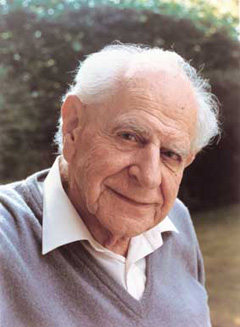
Karl Popper, philosopher of science.Karl Popper was a philosopher of science who is best known for his extension of David Hume's 'problem of induction' and for his work on the demarcation of science.

Popper argued that observation is selective and theory-laden and that there can be no pure or theory-free observations. He further argued that it is possible to select amongst observable data in such a way as to support personally favoured yet invalid theories.

(So-called creation 'science' and intelligent [sick] design theory are not science, and provide clear examples of the misinterpretation and misrepresentation of facts to fit a prior insistence on the existence of a creator. Here, I use prior to indicate that belief in a creator comes prior to the manipulation of the data to support the belief. Creation myths are the invention of humans in almost every culture and are initially invented because of a psychological need for an a posteriori explanation of the natural world. Continuation of such creation mythologies are ensured by post-invention indoctrination.)

Regarding Karl Popper on the topic of the demarcation of science from non-science:
"Formally, then, Popper's theory of demarcation may be articulated as follows: where a ‘basic statement’ is to be understood as a particular observation-report, then we may say that a theory is scientific if and only if it divides the class of basic statements into the following two non-empty sub-classes: (a) the class of all those basic statements with which it is inconsistent, or which it prohibits — this is the class of its potential falsifiers (i.e., those statements which, if true, falsify the whole theory), and (b) the class of those basic statements with which it is consistent, or which it permits (i.e., those statements which, if true, corroborate it, or bear it out)."
Thornton, Stephen, "Karl Popper", The Stanford Encyclopedia of Philosophy (Winter 2006 Edition), Edward N. Zalta (ed.), URL

Labels: , , , , , ,

Scientia

Experimental science is typically conducted in laboratories, though much science is conducted in the field.The term science derives from the Latin word for knowledgescientia. Although laymen tend to confuse science with the areas investigated by scientific method, science strictly refers to a systematic method of attaining knowledge about the physical world.

Scientific 'knowledge' inheres both observed, empirical data and the best possible explanation regarding the mechanisms by which the observed phenomena came about and the prediction, where appropriate, of any future manifestations that can reasonably be expected. Scientific method is most appropriately applied to natural, physical phenomena, and methodology defines the subject areas appropriate to investigation.

Historically, early Western scientists believed that their empirical observations were a cataloguing of God's works. However, science ultimately became religion-neutral. As understanding of the operations of the physical world increased, it became obvious that there is no logical necessity to invoke miraculous explanations for natural phenomena. Much to the chagrin and denial of creationists, God has been squeezed out of the shrinking gaps in scientific knowledge. As a result, scientists, those with higher education, and those with higher IQ are more likely than the general population to accept the fact of biological evolution, and to be agnostic or atheist.

ɷ Behe Retreats
ɷ Complexity Reductio
ɷ God of the Gaps
ɷ Irreducible Illogic
ɷ Through the Microscope Brightly
ɷ We, the Products of Blind Evolution

ɷ biological evolution
ɷ inductive vs deductive
ɷ science

Labels: , , , , , ,

Recommended

Critical Thinking:
Critical Thought

Evolution:
General Science and Evolution,
Human Evolution, Becoming Human: Paleoanthropology
List of pro-evolution or anti-creationism websites,
Panda's Thumb,
TalkOrigins The primary reason for this archive's existence is to provide mainstream scientific responses to the many frequently asked questions (FAQs) that appear in the talk.origins newsgroup and the frequently rebutted assertions of those advocating intelligent design or other creationist pseudosciences.

Labels: , , , , , , ,

Sitia Non Grata

We will not provide any direct links to blogs run by and for anti-science, pseudoscience-inventing, religious nutters or hate-mongering bigots because to do so would be to unwillingly add to the "authority" of such nonsense. However, we will provide links for anyone interested in googling for such sites.

Search engines, like computers, are blind to the value of content on websites and rank highly those sites that are linked to by other sites. To provide a url to creationist, or any other nonsense, is to inadvertantly appear to be giving that site a vote of confidence.

We suggest that any evolutionist or liberal thinker who agrees with this policy do likewise. It's a start.

Conversely, we will provide urls for sites that, by virtue of supporting truth or being well written, deserve a vote of confidence.

The sites that do not deserve any implicit vote of confidence can be googled at:
Answers in Genesis, AiG : Center for Science and Culture : Creation Museum : Discovery Institute :

Labels: , , , , , , ,

Quo Vadis?

As the number of posts mounted, the site map became cumbersome and slow to load, so we have subdivided the map into sectional maps by category:


ɷɷ Atheism Theism Backlash
ɷɷ Bible Bumping
ɷɷ Canadian Bacon
ɷɷ Department of Silly Ideas
ɷɷ Design Debunked
ɷɷ EQ (emotional IQ)
ɷɷ Evolution of Ideas
ɷɷ Ex Ducare (Education)
ɷɷ Fancy Ticklers
ɷɷ FLQ (Functional Level of IQ)
ɷɷ FOL-ly (Fallacies of Logic)
ɷɷ Galleria
ɷɷ Love of Wisdom (Philosophy)
ɷɷ Nuts' Landing
ɷɷ Oh, the Humanities
ɷɷ Peregrinations
ɷɷ Political Shenanigans
ɷɷ Q & A
ɷɷ ¿Que es Mimble Wimble?
ɷɷ Quizling
ɷɷ Scientia
ɷɷ Sitia non Grata
ɷɷ Theocracy Aversion
ɷɷ Variegata dysfunctionosa
ɷɷ What's in a Word
ɷɷ Odds at End


Labels: , , , , , , , , , , ,

. . . launched (sans champagne, alas) 10/22/06