





Agnostic vs Atheist
 "It is wrong always, everywhere, and for anyone to believe anything upon insufficient evidence”
~ W. K. Clifford (1879)
Those of religious bent and the fantasy prone choose to believe what they choose to believe. Such individuals seem to select whatever opinion provides most emotional appeal without regard to logic or empirical evidence.
Religious types come in various levels of dogmatism and subscribe to different human-invented creeds. Most are theists, whereas others believe in equally nutty nonsense like the so-called "Science of Mind" that has zip to do with science.
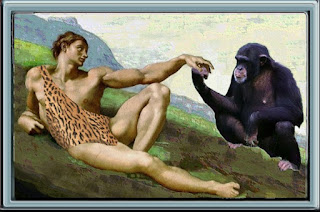
Creationists of various ilks deny our close relationship (more than 98% shared DNA) with the chimpanzee in order to protect their illusion of Special Creation.
Technically, an agnostic holds that the existence or nonexistence of a supernatural deity is unknowable. While this is philosophically rigorous, what is the point of copping out by leaving room for the indeterminable supernatural?
As soon as a supposed supernatural entity has interacted with the physical, then that purported supernatural agent has entered the realm of the physical and has abandoned supernatural status. Those religions that include creation myths necessarily make a claim that the formerly-supernatural has interfered with the physical. This creation-interaction must, by definition, reduce, or elevate, the supernatural to the physical. Goodbye special supernatural status.
Agnosticism can take the position that the possibility that whatever claimed teapot or deity actually exists is vanishingly small, but agnosticism allows some wiggle room for the vanishingly remote possibility that any particular candidate-claim has validity.
Whereas agnosticism carefully perches on the fence, atheism expresses more certainty than to say, "we just can't know". The small "a" atheist simply says, "I don't believe that God exists", wheras a capital "A" Atheist is certain that, "God does not exist." Philosophical purism aside, all the evidence indicates that the God of the Bible does not exist.
Christians, my prime targets in this expose-stupidity campaign, hold that their supposed Creator did indeed interfere in the physical up until 2,000 years ago, since which time God appears to have understandably grown bored with Christians. Of course, Christians keep this conditionally-loving God on hand for their supposed afterlife, aka death.
Bertrand Russell was a famous debunker of religious nonsense and said in Is There a God?, “If I were to suggest that between the Earth and Mars there is a china teapot revolving about the sun in an elliptical orbit, nobody would be able to disprove my assertion provided I were careful to add that the teapot is too small to be revealed even by our most powerful telescopes. But if I were to go on to say that, since my assertion cannot be disproved, it is an intolerable presumption on the part of human reason to doubt it, I should rightly be thought to be talking nonsense. If, however, the existence of such a teapot were affirmed in ancient books, taught as the sacred truth every Sunday, and instilled into the minds of children at school, hesitation to believe in its existence would become a mark of eccentricity and entitle the doubter to the attentions of the psychiatrist in an enlightened age or of the Inquisitor in an earlier time.”
Russell, as ever, makes a good point. Any fantasist can concoct any fanciful story, padded with a layer of non-falsifiable protection, and can insist that the story is accurate by virtue of the glitch that it cannot be disproven. Such a claim, of course, commits the logical error of argumentum ad ignorantiam. If the claim was first made in antiquity, it is imbued with an undeserved veneer of credibility.
The invention of supposed prophecies did not, of course, end with Jesus. Supposed prophets have been popping up with dismaying regularity since Jesus' preachings.
The problem for creationists, particularly for YECs, is that Genesis does make falsifiable physical claims that do stand disproven by science. Somewhere along the way, some creationist has comprehended enough science to realize this major problem and the era of Misleading Pseudoscience for Dummies was ushered in. The fact is, creationists promulgate ignorance and falsehoods in support of what they mistakenly call "Truth". YECs lie about the actual age of the Earth, while believers in pseudointellectual intelligent [sick] design theory accept the actual age of the Earth, but lie about the identity of the supposed-designer, and distort science ranging from cosmology to evolutionary biology.
Considering the ubiquity of invented religions, evolution clearly has not expanded our intellectual capacities to a sufficient degree for humans to justifiably designate our species as "sapiens" and certainly not as "sapiens sapiens".
___
"An atheist is a man who has no invisible means of support."
Labels: agnosticism, atheism, creation myths, creationism, creationists, id theory, intelligent design, pseudoscience, supernatural, YEC
mutterings by Contributors | 9/29/2007 05:59:00 AM
|
0 comments


