http://rpc.technorati.com/rpc/ping

bLogos

Grump tank for disgruntled atheists.

Lending NO authority

We will not provide any direct links to blogs run by and for anti-science, pseudoscience-inventing, religious fanatics, or hate-mongering bigots because to do so would be to unwillingly add to the "authority" of such nonsense. However, we will provide links for anyone interested in googling for such sites.

Search engines, like computers, are blind to the value of content on websites and rank highly those sites that are linked to by more other sites.

To provide a url to a YEC, creationist, hate-mongerer, or any other nonsense, is to inadvertantly appear to be giving that site a vote of confidence, pushing it higher on searches. We will avoid doing this. We suggest that any evolutionist or liberal thinker who agrees with this policy do likewise. It's a start!

Conversely, we will provide urls for sites that, by virtue of supporting truth or being well written, deserve a vote of confidence.

Non-approved creationist sites (junk tanks) are described internally at"
Asses in Genesis, AiG : Discovery Institute : Creation Museum (Cananadian version) :

Non-approved hate tanks:
Family Research Institute :

Persona non grata described internally:
Anti-gay bigot Dr. Paul Cameron :
ID proponent Dr. Michael Behe :
YEC-er Ken Ham, image (see Biblical battle of creation groups) :

The sites that do not deserve any implicit vote of confidence can be googled at:
Answers in Genesis, AiG : Center for Science and Culture : Creation Museum : Discovery Institute : International Society for Complexity, Information, and Design, ISCID :

Persona non grata can be googled at:
Paul Cameron : William Dembski : Ken Ham :

Labels: , , , , , , , , ,

Behe Retreats

Michael J. Behe, populariser of pseudoscientific mumbo-jumbo for credulous creationists.Michael Behe's illogical arguments for intelligent [sick] design theory are such an embarrassment that Lehigh University has placed a disclaimer on their Department of Biological Sciences website:

"The sole dissenter from this position, Prof. Michael Behe, is a well-known proponent of "intelligent design." While we respect Prof. Behe's right to express his views, they are his alone and are in no way endorsed by the department. It is our collective position that intelligent design has no basis in science, has not been tested experimentally, and should not be regarded as scientific."

One can only imagine that if Behe had not already had tenure when he began publishing religious pseudoscience, then the university would have sent him packing to knock on the doors of that infamous junk tank, the misnamed Discovery Institute.

In The New Republic, Professor Jerry Coyne has published a good critique of Behe's retreat from disproven "irreducible complexity" into attributing mutations to God's intervention. The Edge of Evolution: The Search for the Limits of Darwinism is Behe's feeble attempt to conjure up creationist pseudoscience for credulous dummies.

Labels: , , , ,

Claims that Scientists find Extraterrestrial genes in Human DNA

Try googling "Scientists find Extraterrestrial genes in Human DNA" and you will come up with a number of dubious appearing, and even more dubious sounding, websites purporting that a team led by the fictitious Professor Sam Chung claims that human "junk DNA" indicates the operation of apparent "extraterrestrial programmers".

The first clue that this rumor is itself *junk* is the fact that none of these websites provide a reference or url leading back to the purported original work.

The second clue is the nature and name of the websites (though I admit that "Mimble Wimble" may not inspire confidence).

The third clue is the content itself. To quote the ridiculous article: "The alien chunks within Human DNA, Professor Chang further observes, "have its own veins, arteries, and its own immune system that vigorously resists all our anti-cancer drugs.""

Whatever nutbar perpetrated the original hoax, he or she clearly has absolutely no idea of the nature of DNA, which comprises nitrogenous bases attached to a phosphate-deoxyribose (sugar) backbone. Veins, arteries, and the immune system are comparatively enormous systems whose production and operation is coded for by thousands of DNA segments. DNA itself is merely a very large, though essentially simple, molecule and as such it contains only other, smaller, simple molecules.

The hoax-article proceeds from mistake to mistake to mistake. For example, any legitimate scientist at the Human Genome Project would know that "junk DNA" does contain some coding sequences.

No doubt, the Internet community of creationist nutters, themselves usually UFOs* , will eventually latch onto this hoax as "evidence" for the operation of an "intelligent designer". However, one would have hoped that an *intelligent* designer should not have needed to resort to "junk" DNA.

* Uninformed Foolish Objects

Labels: , , , , , , , ,

Myths Revered and Myths Exposed

Different Views of Dinosaurs – the Ham-headed-dinosaur, a genetically altered relic of ignorant thinking. Two very different museum exhibits have hit the news recently (5/26/07).

First the bad news: "Creation Museum juxtaposes dinosaurs, Noah's Ark"
This monument to stupidity in Petersburg, Kentucky was erected under the direction of Ken Ham. He's the expatriate Queenslander who founded the oxymoronically-titled Answers in Genesis ministry. Ham's "non-profit" organization came up with $27 million to build a 60,000-square-foot museum devoted to biblical literacy and creation mythology.

Says Ham, "The Bible doesn't talk about fossils, but it gives you a basis for understanding why there are fossils around the world."

Understanding? Ham is not interested in understanding, Ham is interested in promoting nonsensical insistence that Genesis is not allegorical. Of course the Bible doesn't mention fossils – the ancient tribesmen of Israel who invented the Genesis-creation-myth knew nothing of fossils.

"Christians across this nation see this place as a rallying point," Ham said. They "recognize that we live in a culture that no longer believes the Bible is true."

Misleading! Only some Christians are so deluded that they believe that the Bible is literal, though I suppose that religious dogmatists are spread across America. The museum is actually a rallying point only for those Christians who are so ignorant as to insist upon Special Creation. The only good news is Ham's admission that most of the "culture" no longer takes the Bible literally.

Ham said the museum received three gifts topping $1 million, which only goes to demonstrate that the deluded may become rich. On the other hand, perhaps chimpanzees have funded this inanity in order to divorce themselves from the deluded amongst their cousins.

Ham has filled the museum not with dioramas but with lie-oramas, displays that lie about paleontology. The dinosaurs disappeared some 65 million years ago, when the only evidence of mammalian ancestors comprised tiny insectivores. Hominids did not evolve until the Miocene.

Why dinosaurs in such an exhibit? Children love dinosaurs, and if you wish to inculcate creation myths into another generation you must con the kiddies.

To demonstrate that two can play at the game of deceptive imagery, I have created the Ham-headed-dinosaur to illustrate "Different Views of Dinosaurs".

Some good news is that Ham's lie-oramas have excited well-deserved criticism and that protests are planned.

The other exhibit deals with the phenomenon of myth building in a realistic way:
Dragons and other mythic creatures featured in NYC museum exhibit

"What's going on? Has one of the pre-eminent science museums in the world made a find that would show these creatures are real? No, no, the exhibit actually looks at how people have come up with all kinds of myths and stories to account for things they didn't understand.

The exhibit shows how cultures around the world came up with such strange, mysterious creatures. Dragons, for instance, can be found both in the East and West, although they're considerably more benevolent in Chinese culture than they are in Europe. "

That's more like it – display that consititutes an acknowledment that ignorance promoted fantasy.

More mutterings about the stupidity that is creationism:
ɷ Creationism only flourishes amidst Ignorance
ɷ un-designed intelligences
ɷ Judge Jones Rules
ɷ The Wedge Document


Labels: , , , , , , , , ,

un-designed intelligences

In my opinion, the concept quoted below warrants lower case and reaction to the concept ought to evoke UPPER case refutations.

"Objectivity results from the use of the scientific method without philosophic or religious assumptions in seeking answers to the question: Where do we come from?"

So far, so good. This is the whole point of scientific investigation as embodied in numerous branches of empirical and experimental investigation. The trouble is that the writer is not really interested in learning where we come from, rather he or she is interested only in promulgating an older-than- two-thousand-years creation myth.

Of course, the above quote would not have evoked mimbling if subsequent statements were not contradictory:
"We promote the scientific evidence of 'intelligent [sick] design' because proper consideration of that evidence is necessary to achieve not only scientific objectivity but also constitutional neutrality."

There is no scientific evidence that points directly and incontrovertibly to the operation of an "intelligence" behind the evolution of biological complexity. Creationists choose to interpret the physical evidence as sign of the operation of a deity, just as the creators of other creation myths have done.

However, mainstream science involves not merely collection of data, it also demands that acceptable inferences be made from the data toward expert-scrutinized scientific hypotheses, theories, and laws that reasonably explain physical mechanisms. Most creationists appear to be ignorant of the content and the process of science. Merely discussing science, as I am here, does not constitute science.

Science, by definition, can only investigate the physical, and scientists can only speculate about the natural world in light of physical principles. The purpose of science is the elucidation of mechanisms that operate in the physical world, so legitimate science speculates neither on the supernatural nor on the existence or nonexistence of purported deities.

This said, unbiased, scientific understanding objectively points away from the existence of a supernatural intelligent designer toward mechanisms that select blindly for inherently successful mechanisms. If this were not the case, Christian literalists would not attack scientific understanding of the origins of life and the evolution of biological complexity, instead they would espouse mainstream science.

Further, "neutrality" behooves a lack of bias, a lack of ulterior motive or hidden agenda. No matter what their duplicitious protestations may be, those who promote the concept of "intelligent" design do have an agenda that is unrelated to scientific objectivity – they wish to promote creationism and their right-wing social agenda by pushing thinly disguised religion into the science classroom. It is a credit to many American parents, educators, and judges that the invidious inroads of ‘intelligent [sick] design' propagandists are being overthrown.

It has been my unhappy observation that few people know more than a smattering of scientific facts and even fewer understand scientific principles. However, many reasonable thinking Christians are not so closed-minded as to deny the expertise of scientists in order to protect their emotional need for a belief in a deity. Recognition of biological evolution does not preclude personal religious belief. Religionists, however, exhibit not only different sectarian beliefs they also exhibit different degrees of obtuseness.

Labels: , , , , , , , , ,

Fistians and Fuzzy Illogic

Fundamentalist Christians have taken to calling themselves evangelical Christians because "fundamentalism" excites deservedly negative sentiments. The name may have changed, but the problems remain the same.

I have decided to refer to rigid, right-wing, bigoted, Biblical literalist creationists as Fistians. These are the Christians who give Christianity a bad name because of their unJesusian lack of compassion and their obstinate ignorance in opposition to knowledge. (I considered coining the term Fustians, but opted to rhyme with Christians. I reserve 'fundamentalists' for anti-modernist movements in various religions. Besottism refers to a subset of zealots.)

Fistians and pseudointellectual advocates of intelligent design creationism share the religiosity-motivated credulity that typifies LAME thinking in the Misinformation Explosion Age.

David Colquhoun addresses this problem of intellectual dishonesty and fuzzy illogic in a Guardian Unlimited article entitled the age of endarkenment.

The past 30 years or so have been an age of endarkenment. It has been a period in which truth ceased to matter very much, and dogma and irrationality became once more respectable.
Colquhoun is author of the Improbable Science blog in which he expands upon his exposition of the reasons that we should be concerned about the "New Credulity.":

This matters when people delude themselves into believing that we could be endangered at 45 minutes' notice by non-existent weapons of mass destruction.

It matters when reputable accountants delude themselves into thinking that Enron-style accounting is acceptable. It matters when people are deluded into thinking that they will be rewarded in paradise for killing themselves and others. It matters when bishops attribute floods to a deity whose evident vengefulness and malevolence leave one reeling. And it matters when science teachers start to believe that the Earth was created 6,000 years ago.

In my opinion, the root causes of this problem of fashionable ignorance lies in a number of failures:
● the failure of educational systems to teach critical thinking skills and to instil a love of learning and truth-seeking.
● the failure of the media to make it clear which competing position is valid, rather than boosting ratings by pumping up the volume on issues that supposedly have no clear right side and wrong side.
● the failure of experts to insist that expert knowledge should not be discarded simply because it is opposed by a vociferous, jeering, ignorant rabble of the religiously motivated.
● the failure of those in power – such as Giorgio Dubaya Bush – to eschew endorsement of religiously motivated ignorance.
● the failure of polite liberals to point out the deluded and deceptive content of creationist pseudoscience and unfounded attacks on scientific knowledge.
● the failure of the lay public to doubt popular bandwagons and to realize that they must be cautious about what or whom to believe in this Misinformation Explosion Age.

And, very difficult or impossible to remedy:
● the failure of religious organizations to ensure that their ministers are well educated and not highly prejudiced.
● the failure of political organizations to ensure that those ministries that are tax exempt are not the religions that preach hatred, lies, and intolerance.
● the failure of search engines, websites providers, and publishers to assess the value of content (for example, search engines can determine whether a site is contaminated by spam and phishing, yet do not provide warning that content is false or unreliable.


Because peer pressure is not confined to teenagers, the public, as Madison Avenue well knows, will respond to that side of an argument that is presented flashily, passionately, repeatedly, and with the appearance of certainty.

The public, particularly that in America, has been deluged with messages from religion, which is treated with dare-not-criticize protection. As a result, America ranks alongside Iraq in its level of religiosity despite its position as the standard population (IQ=100) against which IQ scores are standardized.

However, the price paid for holding religious belief sacrosanct (if you will excuse the pun) includes the confusion of students, the deterioration of educational standards, and the near demise of critical thinking, knowledge, and rationality.

Most people reduce their efforts to the minimum necessary to meet expectations. So, if we permit continued dumbing down of standards and lowering of educational expectations so as to protect self-esteem, intellectual standards will fall still further. So long as we present the implicit and explicit message that truth does not matter and that every opinion counts, we will maintain the ever decreasing standards.

In nations that value education and intellectuals, politicians who live down to the "average guy" image are not elected to the most powerful executive positions. As the world has recognized with disdain, Giorgio, purchased Ivy League degree or not, would not have appealed to voters. More particularly, he would not have appealed a second time to voters were they able to detect executive deceptions.


: Social bookmark this page :
..

Labels: , , , , , , , , ,

The Rationality of A-Deism

A-Deism: the certainty that supernatural beings or forces neither exist nor could interfere with the physical realm without becoming part of the physical. Although concepts of supernatural beings or forces exist, neither these conceptualizations themselves nor personal belief in the conceptualizations constitutes evidence for ascribed existence of a supernatural agency. (This definition is mine, 8/16/07).

A-Deism is based on logical analysis of relevant physical and psychological evidence and does not itself constitute a religion. Critical A-Deistic analysis holds that it is neither necessary nor rational to evoke supernatural pseudo-explanations for the origin of the universe (cosmology), the origin of life on Earth (abiogenesis), or biological complexity (evolution). Further, death marks the end of conscious life, so adeists have neither the expectation of eternal life nor any fear of eternal damnation.

Obviously, this definition is very much like that for atheism:

Atheism is the state either of being without theistic beliefs, or of actively disbelieving in the existence of deities. In antiquity, Epicureanism incorporated aspects of atheism, but it disappeared from the philosophy of the Greek and Roman traditions as Christianity gained influence. (en.wikipedia.org/wiki/Atheism)

Adeism excludes agnosticism, deism, and theism.

Agnosticism: the belief that the existence of God is not knowable. The word is derived from the negative ‘a’ combined with the Greek word ‘gnosis’ which means ‘knowledge.’ Hence, agnosticism is the belief that God cannot be known. (google agnosticism definitions)

Existence: despite religionist assertions to the contrary, the only existence of which humans can be certain is that which we each experience during this life on Earth combined with the physical entities and forces that can be empirically detected or deduced through the detectable.
(http://mimble-wimble.blogspot.com/2005/12/reality-truth.html)

Deism: The belief that God exists but is not involved in the world. It maintains that God created all things and set the universe in motion and is no longer involved in its operation. (www.carm.org/dictionary/dic_c-d.htm)

Deity, divinity, god, immortal: any supernatural being worshipped as controlling some part of the world or some aspect of life or who is the personification of a force. (wordnet.princeton.edu/perl/webwn)

Theism: the doctrine or belief in the existence of a God or gods.
(wordnet.princeton.edu/perl/webwn)

Religion—sometimes used interchangeably with faith or belief system—is commonly defined as belief concerning the supernatural, sacred, or divine, and the moral codes, practices and institutions associated with such belief. In its broadest sense some have defined it as the sum total of answers given to explain humankind's relationship with the universe. In the course of the development of religion, it has taken a huge number of forms in various cultures and individuals. (en.wikipedia.org/wiki/Religion)

Superstition is a set of behaviors that are related to magical thinking, whereby the practitioner believes that the future, or the outcome of certain events, can be influenced by certain specified behaviors. The idea of "good luck" and "bad luck" gives rise to many superstitions, such as the belief that it is bad luck to wear gold and silver together. (en.wikipedia.org/wiki/Superstition)

Magic or sorcery are terms referring to the influence of events and physical phenomenon through supernatural, mystical, or paranormal means. The term magic in its various translations has been used in a number of ways. From the point of view of an established religion, it has often been used as a pejorative term for the pagan rituals of competing ethnic groups, as belonging to an inferior (hence blasphemous or idolatrous) culture. The magic and religion article deals largely with this aspect. (en.wikipedia.org/wiki/Magic)

Miracle: according to many religions, a miracle is an intervention by God in the universe. (en.wikipedia.org/wiki/Miracle).

A Biblical definition of miracle is, "an event in the external world brought about by the immediate agency or the simple volition of God, operating without the use of means capable of being discerned by the senses, and designed to authenticate the divine commission of a religious teacher and the truth of his message (John 2:18; Matt. 12:38)".(www.calvarychapel.com/redbarn/terms.htm)

This blog will employ the definition used by Leibniz, "something that goes against the natural and predictable order of things.” (www.innvista.com/culture/religion/diction.htm)

Sites Elsewhere : Why Complete Materialist? :

Labels: , , , , , , , ,

Agnostic vs Atheist

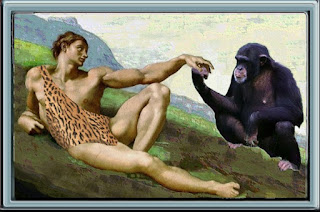
Hominid cousins who share more than 98% of their DNA."It is wrong always, everywhere, and for anyone to believe anything upon insufficient evidence”
~ W. K. Clifford (1879)

Those of religious bent and the fantasy prone choose to believe what they choose to believe. Such individuals seem to select whatever opinion provides most emotional appeal without regard to logic or empirical evidence.

Religious types come in various levels of dogmatism and subscribe to different human-invented creeds. Most are theists, whereas others believe in equally nutty nonsense like the so-called "Science of Mind" that has zip to do with science.

Creationists of various ilks deny our close relationship (more than 98% shared DNA) with the chimpanzee in order to protect their illusion of Special Creation.

Technically, an agnostic holds that the existence or nonexistence of a supernatural deity is unknowable. While this is philosophically rigorous, what is the point of copping out by leaving room for the indeterminable supernatural?

As soon as a supposed supernatural entity has interacted with the physical, then that purported supernatural agent has entered the realm of the physical and has abandoned supernatural status. Those religions that include creation myths necessarily make a claim that the formerly-supernatural has interfered with the physical. This creation-interaction must, by definition, reduce, or elevate, the supernatural to the physical. Goodbye special supernatural status.

Agnosticism can take the position that the possibility that whatever claimed teapot or deity actually exists is vanishingly small, but agnosticism allows some wiggle room for the vanishingly remote possibility that any particular candidate-claim has validity.

Whereas agnosticism carefully perches on the fence, atheism expresses more certainty than to say, "we just can't know". The small "a" atheist simply says, "I don't believe that God exists", wheras a capital "A" Atheist is certain that, "God does not exist." Philosophical purism aside, all the evidence indicates that the God of the Bible does not exist.

Christians, my prime targets in this expose-stupidity campaign, hold that their supposed Creator did indeed interfere in the physical up until 2,000 years ago, since which time God appears to have understandably grown bored with Christians. Of course, Christians keep this conditionally-loving God on hand for their supposed afterlife, aka death.

Bertrand Russell was a famous debunker of religious nonsense and said in Is There a God?, “If I were to suggest that between the Earth and Mars there is a china teapot revolving about the sun in an elliptical orbit, nobody would be able to disprove my assertion provided I were careful to add that the teapot is too small to be revealed even by our most powerful telescopes. But if I were to go on to say that, since my assertion cannot be disproved, it is an intolerable presumption on the part of human reason to doubt it, I should rightly be thought to be talking nonsense. If, however, the existence of such a teapot were affirmed in ancient books, taught as the sacred truth every Sunday, and instilled into the minds of children at school, hesitation to believe in its existence would become a mark of eccentricity and entitle the doubter to the attentions of the psychiatrist in an enlightened age or of the Inquisitor in an earlier time.”

Russell, as ever, makes a good point. Any fantasist can concoct any fanciful story, padded with a layer of non-falsifiable protection, and can insist that the story is accurate by virtue of the glitch that it cannot be disproven. Such a claim, of course, commits the logical error of argumentum ad ignorantiam. If the claim was first made in antiquity, it is imbued with an undeserved veneer of credibility.

The invention of supposed prophecies did not, of course, end with Jesus. Supposed prophets have been popping up with dismaying regularity since Jesus' preachings.

The problem for creationists, particularly for YECs, is that Genesis does make falsifiable physical claims that do stand disproven by science. Somewhere along the way, some creationist has comprehended enough science to realize this major problem and the era of Misleading Pseudoscience for Dummies was ushered in. The fact is, creationists promulgate ignorance and falsehoods in support of what they mistakenly call "Truth". YECs lie about the actual age of the Earth, while believers in pseudointellectual intelligent [sick] design theory accept the actual age of the Earth, but lie about the identity of the supposed-designer, and distort science ranging from cosmology to evolutionary biology.

Considering the ubiquity of invented religions, evolution clearly has not expanded our intellectual capacities to a sufficient degree for humans to justifiably designate our species as "sapiens" and certainly not as "sapiens sapiens".

___

"An atheist is a man who has no invisible means of support."

Labels: , , , , , , , , ,

Declaration of Independent Thinking

Fallacious ad hominem attacks directed at Richard Dawkins have proliferated on the internet.

Religionists are obviously upset at further confirmation that not everyone shares their views and that some of us are becoming more vocal about this.

Thankfully Christian religionists are no longer attacking those from different denominations as heretics or defaming those from different faiths as being infidels. Rather, Christians, particularly evangelical (fundamentalist) Christians and Biblical literalists continue their illogical and ill-informed attacks on those areas of scientific knowledge that disprove the Book of Genesis.

Not only are religionists worried that their attempts to promote creationism are meeting resistance from evolutionary biologists such as Dawkins, but they are scandalized that Dawkins is "promoting" atheism and some have been so ridiculous as to claim that Dawkins is heading up a cult, founding a religion, and converting those lacking powers of critical thinking to adopt an atheistic lifestyle in response to Dawkins' charismatic personality. If Dawkins were converting, by sheer force of personality, those incapable of critical thinking, then we should have seen mass conversions from creationism to atheism.

In point of fact, Dawkins is merely encouraging those who are already atheists to stand up and be counted.

Read Richard Dawkins' Introduction to The Out Campaign here: "Religious people still outnumber atheists, but not by the margin they hoped and we feared."

My atheism began in early childhood with an awareness that God was a human invention. On the basis of the illogic inherent in any belief in supernatural creation of life and humans, I reached personal disbelief before my teens, and reached certainty that no supernatural deity exists by early adulthood.

My logic-based convictions do not, of course, prove that there is no God any more than fervent claims of religious experiences can vote a God into existence. (This should not be a numbers game, though it is refreshing to see that there are so many of us.) Equally, a declaration of atheism does not prove that biological evolution is a fact or that current evolutionary theories provide a complete explanation for the observed phenomena. Demonstration of the fact is provided by the voluminous, multi-field evidence, and refinement of the theory grows with each empirical find.

As Dawkins suspects, I, like so many atheists, have previously made little fuss about my absolute certainty that there are no gods. I have long practiced religious tolerance, and I do not see atheism so much as a manifestation of religious intolerance as an insistence on truth. However, as one of scientific bent and education, I am as thoroughly fed up with anti-scientific, bigoted, illogical, ignorant, deceitful, self-advertizing, self-congratulating religionists as they are dismayed by the persistence of scientific refutation. The atheist backlash is late in coming and I am sufficiently ticked off to stand up and proclaim a conviction that I reached long ago by way of critical thinking. It is impossible to prove a negative, just as it is impossible to demonstrate the existence of something that does not exist.

I predict that the next stage in the creationist campaign will probably involve a proliferation of purple Rs, Cs, Gs, or even JCs on blogs and internet websites. Ken Ham could come out with an "AiG" emblazoned t-shirt showing him posing with a dino, Behe could market the image of a bacterial flagellum, or Dembski could profit from a "filter" logo. If they do, I want a commission for thinking of it first. Or did I?

Sites Elsewhere: Come out! : blog reaction to The OUT Campaign : 5 blog reactions


: Social bookmark this page :

Labels: , , , , , , , , ,

Besottism

Typically, besotted individuals have a dreamy, glazed appearance.

(No prize for guessing whose are the adoring eyes in the image at left.)


Sad is the person whose existence feels empty without belief in some invented Authoritarian Parent in the Sky.

It is amazing how many people are in love with God, Jesus, the Catholic Church, Allah, Jehovah, or whatever cult figure. I am not merely talking of "loving" but instead of that besotted, chemistry-driven, starry-eyed, obsessive, worshipful state that we equate with "being in love". The religiously besotted are convinced that their adoration does not go unrequited, and that they will be rewarded for their diligent obsession by spending eternity basking in the love of their chosen One.

In this admittedly demented state, those who are obsessed with their object-of-choice are immune to logic. The besotted close their minds to any dissonant information about their object-of-obsession. Thus, fundamentalist creationists refuse to acknowledge the fact of biological evolution, preferring the ignorance of misleading pseudoscience for dummies.

Rather than using the term religious zealot, I am dubbing these menaces, "Religious Besotts". Historically, rulers took advantage of Besottism, claiming that they ruled by Divine Right, and demanding obediance, even martyrdom, from the besotted in the realm.

Religious Besotts are dangerous people because nothing and nobody matters more to them than do their enamored delusions. While they adore their obsession-of-choice, they hate with equal passion all that they perceive as threatening to their obsession. Because their besottism usually follows politically accepted religions, they feel vindicated in their adoration and justify their moralistic and political hatreds as obedience to their deity's instructions. The religious right believe that they adopt the high moral ground when they churn out ill-conceived arguments against the-right-to-choose or the right to act according to the gay nature with which some are born.

Sadly, not only are religions permitted by states, but religions are protected and tax-exempted.

Most religious individuals are not dangerous, but collective religious besottism is a dangerous force. Throughout history, religious besotts have felt justified in murdering others who do not share their besotted view, labelling the others as infidels, or heretics, or undesirables. Religious besotts do not consider that others have the right to live their lives according to individual preferences and conscience, but instead believe their obsession-of-choice confers upon them the right to dictate to others.

Besotts build their arguments for Deity-given-morality on quicksand because there is no good evidence that any deity-of-choice actually exists. Claims that Besotter attacks on the behaviors of others are justified by whatever Book-of-Besottism are circular and equally ill-founded. After all, these Books are just the ramblings of Ancient Besotts.

Labels: , , , , , ,

YEC yack

God of the Gaps pens Misleading Pseudoscience for Dummies, an allegorical text that scores Z- in science.Rather than merely editorialize the fact that creationists hold unfounded opinions and make illogical arguments, here are comments on some snippets of their views:

C1: "I would like to meet the "scientist" that can PROVE that evolution is true and not a theory."

Of course this writer would not really like to meet any such scientist because creationists display absolutely no desire to understand reality.

Symptomatic of their black-and-white thinking, creationists love to make challenges demanding proof. Biological evolution is a demonstrable fact upon which theories of evolution are based. The evidence for biological evolution has been pronounced as "overwhelming" by credible experts in the field. Facts can be empirically demonstrated, but no scientific theory, or any other inference based on induction can be proven, though hypotheses and theories and claimed-to-be-facts can be disproven. The writer goes on:

C1: "That of course is impossible since no one was living millions and billions of years ago, and I mean NO ONE and NOTHING."

This is patently untrue! There is abundant evidence that life existed on this planet several billion years ago.

C1: "There are plenty of Creation Scientists that can show proof as to why the earth can only be 6000 years old(give or take a couple of hundred years)."

There are NO creation scientists because creationisms is religion and not science, so "creation scientist" is an oxymoron. The statement is completely untrue. Falsifying details and publishing unfounded attacks on scientific facts does not constitute science. No matter what an individual's educational background, fallacious argumentum ad verecundiam pronouncements that run counter to the facts and to the knowledge of credible experts in a field are without any value as science.

The mythical YEC figure of 6,000 years is based on Bishop Usher's Bible-based estimate. Science has categorically demonstrated that the Bible is incorrect in its depiction of dates–in effect, disproven.

C1: "Carbon dating and other dating methods that the scientific community has relied on for so long now are proving to be very inacurate and more and more evidence keeps popping up to prove thousands of years instead of millions or even billions of years."

No scientist claims that carbon dating can be applied to dates earlier than 70,000 years ago. Other radioactive isotopes with longer half-lives are employed in obtaining the older estimates, which are always reported with the range of error indicated. Creationists are typically woefully ignorant of actual science, preferring as they do to parrot the pseudoscientific falsifications on junk tanks such as AiG. The planet is approximately 4.7 billion years old, no matter how many times ill-informed and biased YECs claim that Usher's date is accurate.

C1: "When is the "scientific" community going to take its head out of their "evolutionary ooz" and realize that CREATION IS SCIENCE!"

Shouting does not help this writer's ridiculous argument. Science is based on application of empirical scientific methodology, creationism is religion based on an ill-founded assumption of Biblical literacy. Creationists have attempted to hijack science in order to strengthen their received, preconceived notions of Biblical inerrancy. They will never succeed in convincing any but the already-deluded because scientific methods have disproven the Biblical statements that relate to scientific areas. The Bible is an allegorical creation myth followed by pseudohistorical moral fable.

C1: "God was the originator of science and created everything we see, and plenty of things that we don't even know exist yet."

Creationists seem to believe that whatever nonsense they make up about their supposed God will hold true simply because they say so. Such thinking is totally in keeping with the emotionality, obstinate ignorance, and illogic of their arguments. If God originated science, then the Bible is the received Misleading Pseudoscience for Dummies text, and God scores a Z- in science.

C1: "I can't imagine holding onto the idea that we evolved from some "ooz" of some of some sort and that's all we are, an accident, and there is no purpose to our lives. I think that's very sad."

That says it all. The writer, for highly emotional reasons of his or her own cannot imagine how life could have arisen from chemicals and then evolved. This is a failure of comprehension, a failure of logic, and deliberate ignorance of established facts. A sense of purpose is a psychological phenomenon. If the writer cannot sense some purpose to his or her life without being the product of Special Creation, then that, in addition to manifest and obstinate ignorance about reality, is very sad indeed.

Here's another creationist stating YEC beliefs:
C2: "YEC does not say that God created all animal life, for example, in the state it is in today. YEC does not deny that some biological evolution occurs. YEC believes that change does occur (what they believe actually requires it) but YEC believes that change can only happen within a created kind."

Because there is so much evidence for continuing biological evolution (covered by the creationist buzzword microevolution) creationists see nothing to be gained in denying that, for example, bacteria can acquire antibiotic resistance. Creationists do not perceive currently occurring genetic change as a threat because they are obsessed with denying the distant past (biopoiesis and macroevolution) in order create that gap into which they insert the man-invented notion of Special Creation.

The reference to design pays homage to intelligent [sick] design theory, which is merely creationism in disguise.

C2: "Naturalistic secular science begins and ends with the unfounded assumption that the material is all that exists, that God does not exist, etc., etc."

Of course science studies the natural world – scientific method can only be applied to the physical, observable, tangible, and measurable. However, that is the only thing in which C2 is correct. It is not necessarily an unfounded assumption to believe that the material is all that exists, even though scientists concede the physical may not inhere all of existence. Only the material is accessible to the scientific method. The question of existence beyond the physical belongs to speculative philosophy and theology. Science is religion-neutral and does not assume that God does not exist. Scientists may privately believe that there is no deity, particularly in view of the fact that science provides far better explanations than "God brought it about by a miracle." However, scientific method can only be religion neutral. C2 is merely using the creationist buzzword "secular" to attempt to place all scientists in the infidel camp in an association fallacy.


C2: "(Creationism) is not about religion; it is about the Truth."

This is an utter falsehood. Of course creationism is about religion. Creationists and others of religious persuasion make a claim of "Truth" for their beliefs, but they have no good evidential, logical foundation for doing so. This is the reason that the terms "faith" and "belief" are more accurately applied to religious beliefs.

C2: ". . . God, who Jesus is, life after death, but those are all tied to this issue."

If creationism is about God and Jesus, then C2 has just revealed him or herself to have lied when saying that creationism is not religion.

C2: "True, one can be a Christian and not believe in a six day creation, but such a person is not really being consistent in their beliefs. If Genesis is open to such liberal interpretation as some give it, then why not do the same to the resurrection account of Jesus? If there was no literal Adam and Eve that literally disobeyed God (sinned), then there is no need for a Savior."

Yup. This is the underlying reason for dogmatic insistence on Biblical literalism, these black-and-white thinkers are aware that their rigid beliefs will not allow for any latitude. It's no accident that Genesis depicts knowledge as the enemy. Knowledge does not make us sinners, but religious beliefs cannot survive full critical scrutiny.

"Genesis is foundational to the Christian faith, and it is true."

Genesis is an allegorical creation myth that is clung to by particularly reality-ignorant Christians. Genesis is disproven.

"The Bible says that those that do not want to see the Truth will be blinded to it."

Since the Bible was written by men this statement remains accurate concerning the human foible of denial. The fact is that the actual truth is not what creationists credulously take to be "the Truth".

C2: "Those that want to cling to the religion of evolution will always find a way to make it seem right in their eyes."

Poor, fuddled C2 is totally muddled as to what is science and what is religion. Biological evolution is a fact, the modern synthesis of evolution represents the best current scientific explanation of the observable facts. Evolution is not religion in C2's earlier definition, where it is labelled as secular science.

Creationists are typically so illogical that they do not even realize that they are making self-contradictory statements in an attempt to justify emotional beliefs. I suspect that because these individuals desperately want and need to believe that they are the salvation-selected products of Special Creation they become easy prey for any falsehood or illogical argument that appears to support their indoctrinated beliefs. (Let's be honest and call a stupid argument a stupid argument.) The stupid arguments work to support creationists' emotional beliefs, so creationists ignorantly fail to detect the illogic.

The sentence would have been accurate if it had been written as, "Those that want to cling to the religion of creationism will always find a way to make it seem right in their eyes."

No matter how passionately an illogical ignorant argument is made, that argument remains utterly without validity. YEC vehemence is really tantamount to bragging about exhibiting stupidity. It is not surprising that many Christians hold YECs in contempt.

I believe that YEC and ID appeal to those who have a cognitive disorder in that they have not attained an internal desire for logic. Further, most creationists of my acquaintance also appear to lack mastery of many operations of logic.

Piaget's "genetic epistemological" research into the developmental acquisition of cognitive schemas did not proceed beyond the achievement of formal operations by about age eleven. However, beyond the logical schema acquired in childhood, not all individuals attain the full repetoir of logical operations necessary for critical thinking. The worldviews of many adults exhibit considerable philosophical tension, and many adults display internally inconsistent, illogical, emotional reasoning fraught with many of the errors found in fallacious arguments. Religious beliefs, in general, force illogical inconsistencies into the thinking process.

Creationists' arguments on religion are highly emotional, their arguments concerning science are falsehoods, their arguments about morality are rigid and bigoted, their views on politics are usually greed-motivated, hubris-filled, and doggedly unperceptive.


Labels: , , , , , , , ,

Adeism


Sad is the person whose existence feels empty without belief in some invented Authoritarian Parent in the Sky.


Adeism, atheism, and agnosticism are not so much antireligious as rational.

Apologists, deists, theists, creationists, and intelligent [sick] design creationists think fuzzily from the inculcated-a-priori assumption that there must be a deity, so their thinking and arguments include fallacies of logic and, often, falsehoods.

Religionists** and Fistians, as distinct from the merely religious, misrepresent atheism as being merely another "religion" because religionists cannot think outside the dictated-opinions-box. Their beliefs and thoughts are so dominated by religious dogma that they view almost all cognitive systems as being part of a some religion or other. Of course, religious dogmatists believe that their religion is the only correct religion, conveniently ignoring the fact that their religion too could be false. Besots are too in love with religion to question their beliefs.

Creationists are blissfully unaware that in a rational world the argument concerning "creation versus evolution" is already lost to them. They cannot comprehend that the determination of knowledge about the physical world is not a matter of opinion and is not to be decided by popularity polls. Beliefs may be swayed by emotional rhetoric and illogical arguments, but belief is not necessarily equivalent to knowledge. Belief is equivalent to knowledge only when based on facts, on logical arguments based upon true premises and upon logical induction from empirical evidence. Knowledge certainly cannot be realistically claimed to result from misrepresentation and lies.

Despite the fact that deities are the product of fantasy, most creationists lack the imagination and education required to fully grasp the concepts that make the physical world comprehensible, so they miss part of the wonder of the natural world. They have been fooled into believing that science is fraught with uncertainty and inaccuracy simply because it is open to refinement. They believe that the pseudoscientific falsehoods that have been foisted onto them have equivalent truth value to scientific knowledge. Creationists have been taught to distrust experts and yet to believe religiously-biased sources without question. Intelligent design creationists have swallowed a pseudointellectual sweeping generalization and refuse to see that attacking science is not equivalent to doing science. YECs have been taught to believe blatant falsifications and to dismiss experimentally verified facts so as to maintain the delusion that a moral allegory authored by Homo religioso is the "Word of God".

In the mistaken assumption that non-acceptance of the unfounded concept of "Absolute Moral Truths", religionists misrepresent atheists as lacking moral values and mistakenly blame all of the ills of society on secular humanism. This ridiculous prejudice is based on the mistaken assumption that only those who obey weekly sermons can behave morally. In their rigid, intolerant attitudes Fistians routinely act counter to Jesus' compassionate teachings.

** Religionists are those who aggressively make a religion of adherence to rigid religious dogma rather than merely having deistic or theistic beliefs.

ɷ Fistians and Fuzzy Illogic ɷ The Rationality of A-Deism ɷɷ Bible Bumping ɷ Bible Bumping ɷ Agnostic vs Atheist ɷ Agnosticism is NOT more rational than Atheism ɷ Apologists make Apologies for God ɷ Besottism ɷ Canadians Can be Stupid Too ɷ Creationism only flourishes amidst Ignorance ɷɷ Department of Silly Ideas ɷɷ Design Debunked ɷ Dei Non Existent ɷ Dawkins refutes Behe ɷɷ Ex Ducare (Education) ɷ Furor over Stupidity ɷ In God, Distrust ɷ Inverse Correlations ɷ Moral Absolutism ɷ One Evolution, Many Creationisms ɷɷ Scientia ɷɷ Sitia non Grata ɷ Spirituality, Religiosity, and Madness ɷ Statistics on Stupidity ɷɷ Theocracy Aversion ɷ YEC yack


...section index...

Labels: , , , , , ,

One Evolution, Many Creationisms

Man [sic] created God in man's image, and plays with the shape and age of the Earth.Like so much else connected to invented religious belief, creationism comes in a variety of guises in which invented beliefs range from the sublimely ridiculous (flat earthers, geocentrists, and YEC), through the pretentious (intelligent [sick] design theory). The variety of religious and creationist beliefs is directly attributable to the contrived, invented nature of all religious beliefs, none of which comprises an internally consistent logical system based on evidence.

Typically, creationists are theists who cling to religious views with varying levels of dogmatism whilst ignorantly choosing to deny or distort most or part of scientific knowledge. Such ignorance is religiously motivated, substituting varying levels of Biblical literalism and insistence on Special Creation for scientific fact.

At the most realistic, scientific end of this spectrum comes philosophical materialism. The following list is from TalkOrigins:

CREATION
Flat Earthers
Geocentrists
Young Earth Creationists
... (Omphalos)
Old Earth Creationists
...(Gap Creationism)
...(Day-Age Creationism)
...(Progressive Creationism)
...(Intelligent Design Creationism)
Evolutionary Creationists
Theistic Evolutionists
Methodological Materialistic Evolutionists
Philosophical Materialistic Evolutionists
EVOLUTION

Evolutionary science is complex because it includes information from so many areas of science. However, the fact of biological evolution is acknowledged by the majority of scientists and denied only by religiously-biased individuals, most of who are not qualified in the relevant areas.


Labels: , , , ,

Argumentum ad numeram

Appealing to the Gallery, Appealing to Numbers

Argumentum ad numeram and argumentum ad populam are closely related fallacies of logic. Fallacious ad numeram arguments take the position that the veracity of an argument can be determined by the number of people who support or believe the proposition. Fallacious ad populam arguments attempt to win acceptance of an argument by making an emotional appeal to as large an audience as possible.

Giorgio Dubaya Borgia and his administration used ad nauseam emotional appeals (fear of terrorism, Saddam Hussein has murdered Iraqi civilians) to attempt to justify an invasion of extremely dubious merit. Most people are not so foolish as to remain conned forever, and Borgia's approval ratings have plummeted.

However, politicians succeed because large numbers of people are conned by propagandistic appeals to emotion, realizing their errors only too late. (This is the chief problem with democracies – the populace is far too easily duped into voting for candidates who later prove, as did Bush, to have absolutely no merit.) As a result of the gullibility of USians who voted for Bush, al Queda is now operating in Iraq when it did not operate under Hussein. Thousands of soldiers and civilians have been needlessly killed or maimed, and Iraq faces years of civil war before yet another strong man dictator takes over. The only upside of all this stupidity is that the share value of Haliburton has probably increased, and that is not an upside except to greedy Americans.

Religious dogmatists argue that because most people in the US believe that God was their personal creator, then God must exist and must be their creator. This, of course, demonstrates only that most people have been told, from an early age, that there is a God who is their creator and they have believed the tale in the absence of any confirmatory evidence. Unlike the case for Bush's lamentable record, only death could confirm or deny the existence of this purported creator, and the dead cannot inform the still-living that they were duped. If the dead could speak, then I am quite confident that God's approval rating would plummet almost to zero.

Fallacious argumentam ad numeram or argumentam ad populam is particularly damaging in the hands of dishonest politicians, but it is also a general problem amongst those who refuse to believe in the valid, empirical-based knowledge of credible authorities.

Because it is easy and cheap to form and hold an opinion, no matter how ill-informed or illogical that opinion, people with virtually no knowledge of a field will dogmatically insist upon ridiculous notions that run counter to received wisdom from those who are authorities in their fact-based field.

Thus, people who know nothing of meteorology or atmospherics will decide incorrectly that global warming is a myth simply because they do not wish to believe that they must alter their behaviour. People who know nothing of medicine, biomedical sciences, or epidemiology will erroneously decide, for example, that smoking is not harmful, or that vaccination causes autism.
Such errors would merely result in the holding of unfounded opinions by peope not sufficiently informed to host any opinion, but because politicians pander to public opinion, public ignorance becomes translated into harmful political action or inaction.

Labels: , , , , , , , ,

Fallacy Fallacy

Argumentum ad Logicam : Fallacist's Fallacy : Fallacy Fallacy : "Fallacio" :

This fallacy is akin to the two wrongs don't make a right adage. A fallacious argument lacks a convincingly strong logical connection between acceptable premises and relevant conclusion. However, a true conclusion could be tacked onto a fallacious argument (ignoratio elenchi). So, the fact of unacceptable premises and/or an illogical argument says nothing about the truth-value of the conclusion itself. Accordingly, one is not necessarily justified in concluding that a proposition is false simply because a fallacious argument has been presented for the proposition. (The professional proponents of intelligent [sick] design theory implicitly fall back on this escape clause.)

In commenting on the fallacies of logic inherent in creationist arguments, I realize that recognizing fallacies alone does not render creationist conclusions incorrect. Demonstration of the falsity of creationists' claims does require scientific exposition, but that voluminous topic is not the primary purpose of this site. The fact that I, along with experts in the relevant scientific fields, am convinced by the scientific evidence has, however, made me certain that creationists' conclusions are false, and this prompted me to examine the fallacies that must be present in arguments for false conclusions. I can think of no other huge body of fallacious arguments within an area where conclusions are subject to empirical scrutiny. So, religious dogma and creationist nonsense provides ideal fodder for critical thinking. The problem with creationist and intelligent [sick] design arguments–beyond their manifest ignorance of science–lies in the fact that they are fraught with fallacies.

It is theoretically possible, on grounds of logic, that creationists' and intelligent [sick] design proponents' criticisms of science could be well founded. In so far as scientists usually admit that their hypothesis or theory will be subject to subsequent revision, creationists and intelligent [sick] design proponents are correct that gaps do exist in scientific knowledge. Scientists regularly admit that science has unanswered questions. This is one of the features that makes the study of science interesting. The nature of scientific investigation is to incrementally refine the body of understanding. Rarely do scientific discoveries completely overturn previous paradigms. However, unlike the case for religious dogma, nor does science lay claim to having a complete answer.

In this regard, though, it is an argument from ignorance–ignorance of possibilities–to believe that disproving scientific explanations is even possible by intelligent [sick] design propositions, let alone that it could prove the existence of God. Just as a single exposure of a fallacious argument does not overturn creationist arguments, gaps in scientific knowledge do not discredit the broad subject of scientific understanding. To argue so is a fallacy of composition – extrapolating from a part to the whole. In thinking that attacking elements of science could disprove biological evolution, creationists and intelligent [sick] design proponents are creating a false dichotomy, ignoring the actual explanation of incomplete-but-accurate knowledge.

Creationist and intelligent [sick] design arguments, though often implied rather than being spelled out fully, do not constitute a body of argument remotely as strong as empirical scientific evidence, scientific hypotheses, or scientific theories. So, exposure of all or many of the fallacies in the arguments of creationists and intelligent [sick] design proponents is not to commit the fallacist's fallacy: "It is reasonable to, at least provisionally, reject an improbable proposition for which no adequate evidence has been presented. So, if you can show that all of the common arguments for a certain proposition are fallacious, and the burden of proof is on the proposition's proponents, then you do not commit this fallacy by rejecting that proposition. Rather, the fallacy is committed when you jump to the conclusion that just because one argument for it is fallacious, no cogent argument for it can exist." Fallacy Fallacy


Labels: , , , , , , , ,

Slippery Slope

Slippery slope fallacy, thin end of the wedge, camel's nose

The slippery slope fallacy consists of claiming that one thing will inevitably lead to another when there is no good reason to believe that such a sequence will necessarily occur.

The slippery series can be based upon causal or upon semantic relations. In the causal, non causa pro causa, series event "1" leads to outcome "n" by way of a series of steps, which may be explicit, but are often implicit.

Thus, music may lead to dancing, which may lead to sex, which may lead to unwanted pregnancies, which may lead to unwanted children, which may lead to child abuse, which may lead to criminal activity. All because someone turned on the radio!

In the semantic version, two terms that lie on a continuum are treated as though there is no point of distinct transition. Thus, doctor-assisted suicide at the request of a mentally competent, suffering, terminally ill patient is depicted as transitioning directly to physicians playing God and murdering patients at will.

The slippery slope fallacy is commonly employed in the arguments of religious dogmatists who erroneously claim that "moral relativism" will lead to moral decay, and ultimately to moral mayhem. Equally erroneous, and tied into creationist awareness that Darwin was the first to shed light on the actual mechanisms of biological evolution, religious dogmatists like to link Darwinism to moral laxity. The Wedge Document anonymously decries "the catastrophic legacy of Darwin, Marx, and Freud—the alleged fathers of a “materialistic conception of reality” that eventually “infected virtually every area of our culture.”"

Conversely, civil libertarians might claim that an increase in governmental controls would inevitably lead to a police state. While it might be quite justified to anticipate that extra surveillance powers given to the authorities after 9/11 could be employed to infringe upon the civil liberties of some innocent citizens, it is not necessarily the case that most or all citizens will suffer intrusion.

It is not a slippery slope fallacy, on the other hand, to point out that permitting creationist intelligent [sick] design theory into science classrooms would lead to a further deterioration in the standards of science education.

Quo Vadis?
...section index...

Labels: , , , , , ,

Scientia

Experimental science is typically conducted in laboratories, though much science is conducted in the field.The term science derives from the Latin word for knowledgescientia. Although laymen tend to confuse science with the areas investigated by scientific method, science strictly refers to a systematic method of attaining knowledge about the physical world.

Scientific 'knowledge' inheres both observed, empirical data and the best possible explanation regarding the mechanisms by which the observed phenomena came about and the prediction, where appropriate, of any future manifestations that can reasonably be expected. Scientific method is most appropriately applied to natural, physical phenomena, and methodology defines the subject areas appropriate to investigation.

Historically, early Western scientists believed that their empirical observations were a cataloguing of God's works. However, science ultimately became religion-neutral. As understanding of the operations of the physical world increased, it became obvious that there is no logical necessity to invoke miraculous explanations for natural phenomena. Much to the chagrin and denial of creationists, God has been squeezed out of the shrinking gaps in scientific knowledge. As a result, scientists, those with higher education, and those with higher IQ are more likely than the general population to accept the fact of biological evolution, and to be agnostic or atheist.

ɷ Behe Retreats
ɷ Complexity Reductio
ɷ God of the Gaps
ɷ Irreducible Illogic
ɷ Through the Microscope Brightly
ɷ We, the Products of Blind Evolution

ɷ biological evolution
ɷ inductive vs deductive
ɷ science

Labels: , , , , , ,

. . . launched (sans champagne, alas) 10/22/06